Showing posts with label Stephanie Dray. Show all posts

Tuesday, July 14, 2020

The Women of Chateau Lafayette by Stephanie Dray


Cover Reveal & Author Interview


ABOUT THE BOOK

An epic saga from New York Times bestselling author Stephanie Dray based on the true story of an extraordinary castle in the heart of France and the remarkable women bound by its legacy in three of humanity's darkest hours.

Most castles are protected by powerful men. This one by women...

A founding mother...

1774. Gently-bred noblewoman Adrienne Lafayette becomes her husband's political partner in the fight for American independence. But when their idealism sparks revolution in France and the guillotine threatens everything she holds dear, Adrienne must choose to renounce the complicated man she loves, or risk her life for a legacy that will inspire generations to come.

A daring visionary...

1914. Glittering New York socialite Beatrice Astor Chanler is a force of nature, daunted by nothing--not her humble beginnings, her crumbling marriage, or the outbreak of war. But after witnessing the devastation in France and delivering war-relief over dangerous seas, Beatrice takes on the challenge of a lifetime: convincing America to fight for what's right.

A reluctant resistor...

1940. French school-teacher and aspiring artist Marthe Simone has an orphan's self-reliance and wants nothing to do with war. But as the realities of Nazi occupation transform her life in the isolated castle where she came of age, she makes a discovery that calls into question who she is, and more importantly, who she is willing to become.

Intricately woven and beautifully told, The Women of Chateau Lafayette is a sweeping novel about duty and hope, love and courage, and the strength we find from standing together in honor of those who came before us.

Pre-order: https://bit.ly/3iLkURa
Add to your Goodreads shelf: https://bit.ly/320tkya
Sign up for Stephanie’s newsletter: https://www.stephaniedray.com/fun/newsletter/

 
Q&A WITH STEPHANIE DRAY

 
What made you fall in love with Adrienne Lafayette and why do you think readers will fall for her as you did?

Thanks to a popular musical, the Marquis de Lafayette is known to a new generation as "America's Favorite Fighting Frenchman"--and there's good reason for that. He's easily the most lovable of our Founding Fathers, and his wife, whom he called his dear heart, is just as lovable if not more so. Adrienne was our French Founding Mother, so right up my alley as a heroine, but at first I worried she was too sweet, devoted, and forgiving. In short, too gentle for a novel. Little did I realize that more than any other historical heroine I've ever written, Adrienne fought and sacrificed for her principles, courageously threw herself into danger, confronted tyrants, and endured trials that would have broken lesser mortals. She truly humbles me, and when I talk about the Lafayette legacy, I think of it as every bit as much hers as it is his.

How long did it take you to write this book? Did the story evolve as you researched, or did you always know you wanted to take on the lives of these particular women?

I was always interested in Lafayette--an interest that grew as Laura Kamoie and I co-authored America's First Daughter and My Dear Hamilton. I think I had the germ of the idea for a Lafayette novel at least seven years ago, but I had other projects in the way. And I was always in search of an angle that would be fresh and unique. That came to me when I discovered that Lafayette's castle in Auvergne, which had been purchased and renovated by Americans, served to shelter Jewish children from the Nazis. Knowing how deeply the Lafayettes both felt about religious freedom, I knew this would have pleased them, and it touched me. I was then determined to know which Americans had purchased the chateau, and when I found out, yet another glorious chapter in the Lafayette legacy was born. That's when the story took shape for me about one special place on this earth where, generation after generation, faith has been kept with principles of liberty and humanity. I find that very inspirational, now more than ever.

The book is centered around Lafayette’s castle, the Château de Chavaniac, and the pivotal role it played during three of history’s darkest hours—the French Revolution and both World Wars. If you could have dinner with any three people (dead or alive) at Chavaniac, who would you choose and why?

Believe it or not, this is actually a difficult choice because so many incredible men and women passed through those doors. I'd have to start with the Lafayettes--though I hope they would not serve me pigeons, which were a favorite at their wedding banquet. To join us for dinner, I'd choose the colorful stage-star of the Belle Epoque, Beatrice Chanler, because she was a force of nature without whom Chavaniac might not still be standing. Actress, artist, philanthropist, decorated war-relief worker and so-called Queen of the Social Register, she was as mysterious as she was wonderful, and even after all the startling discoveries I made researching her larger-than-life existence, I have a million questions about the early life she tried so hard to hide. I can't wait for readers to meet her!


Monday, December 30, 2013

Book Reivew: Daughters of the Nile by Stephanie Dray


#3 in the Cleopatra Selene series
Release Date: December 3, 2013
Publisher: Berkley Trade 
Pages: 576
Received: ARC from author
Rating: 4.5 out of 5 stars
Goodreads

This is a review for the final book in a trilogy. There are NO spoilers, but if you're worried, you can read my reviews of the first two books instead: 


Review

Cleopatra Selene and I have been on this journey together for a long time. I started reading her story when she was a child, and by the time Daughters of the Nile comes to an end she has grown into herself as a woman in her thirties.

I've laughed, cried, sympathized, swooned, and raged alongside her as she struggled to grow up under the expectations set by her famous parents (Cleopatra and Marc Antony) and the yoke of the conniving emperor Augustus.

Daughters of the Nile was a satisfying conclusion to Selene's story. Much of it felt like a wrapping up and winding down, and by the final third of the book I definitely felt like Stephanie Dray was gently prying my fingers away and letting me know it was time to let go. The last time I had felt such author awareness to my reader needs for growth and closure was when reading Harry Potter and the Dealthy Hallows, so, kudos and thank yous to Stephanie Dray.

While I feel like I emotionally came to a positive end, the journey there was mixed. I feel like the way things played out was the right and necessary way. The only way. And so I'm very satisfied.

But, I missed Selene's sparring with Augustus. This installment lacked the tense rage and battle sparks I felt when reading the first two books. Part of this is because Selene is growing, and while I miss those interactions, I feel their loss in this sense is a necessary and correct change for Selene's character and life.

Except, Augustus! If I have one complaint, it is that he became a shadow of himself. Stephanie Dray's Augustus in Lily of the Nile and Song of the Nile set the bar for me when it comes to historical interpretations of this man. He was a force to be reckoned with. Cold, calculating, wickedly intelligent and always scheming.

Not so in Daughters of the Nile. Here, he's diminished and changed to the point that he seems almost a parody of himself. His lust for Selene made sense at first, but devolved into deranged obsession I'm not sure sits well with me from both a characterization and historical standpoint.

Then there's the romance. Again, part of me is extremely satisfied with the way things played out. There were scenes of such tenderness and watching these two people grow, come together, falter, learn about one another and themselves, and come together again was everything I want out of a romance.

And part of me can't get over what he did in the previous books.

That Selene was equally conflicted made things better. Trying to take an objective view and see things from his perspective and development helped further, even if that's a really, really hard thing to do (especially since I've been experiencing all of this through Selene's eyes, and she is NOT an objective, forgiving kinda lady).

And that's part of the beauty of the book. It's hard because life is hard. No character is perfect, and none of the situations they find themselves in are perfect either. They make do the best they can, finding joy where and how they can. There were multiple scenes where tears were streaming uncontrollably down my face, both in sadness and joy.

Bottom line

I may have been disappointed with Augustus, but it wasn't a deal breaker. I may have wished some things were different, but the book would have been less had I gotten what I thought I wanted. Ultimately, I love what Stephanie Dray did with this story and that is why the series overall has secured itself a place on my Special Shelf. 


Explanation of rating system: Star Rating Key 


Do you have any questions about Daughters of the Nile that I haven't addressed?
Feel free to ask in the comments!

Looking for another book like this?
You might like:

http://smallreview.blogspot.com/2013/10/series-review-marie-antoinette-by.htmlhttps://www.goodreads.com/book/show/1375656.The_Alexandrian?ac=1


 Click on the pictures to go to my reviews.

Tuesday, December 3, 2013

Book Blast: Daughters of the Nile by Stephanie Dray


Daughters of the Nile slide

From critically acclaimed historical fantasy author, Stephanie Dray comes the long-awaited new tale based on the true story of Cleopatra's daughter.

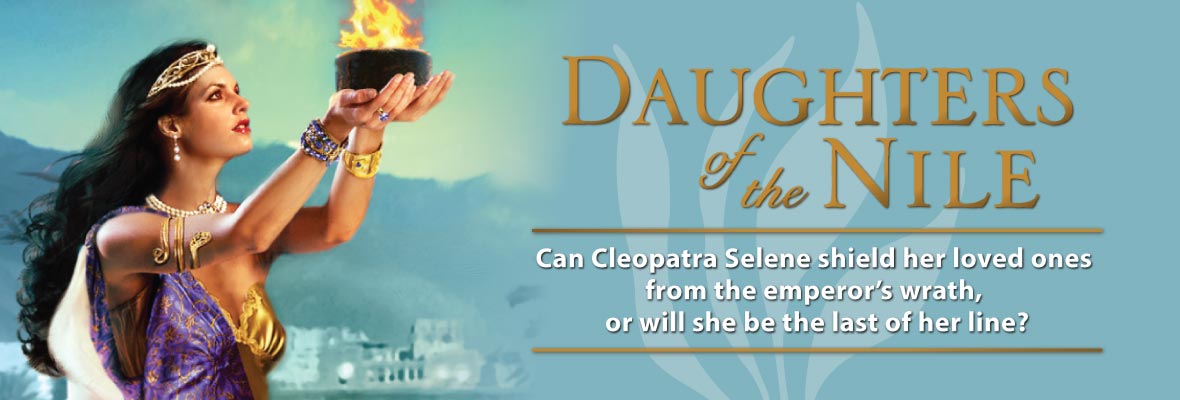
After years of abuse as the emperor’s captive in Rome, Cleopatra Selene has found a safe harbor. No longer the pitiful orphaned daughter of the despised Egyptian Whore, the twenty year old is now the most powerful queen in the empire, ruling over the kingdom of Mauretania—an exotic land of enchanting possibility where she intends to revive her dynasty. With her husband, King Juba II and the magic of Isis that is her birthright, Selene brings prosperity and peace to a kingdom thirsty for both. But when Augustus Caesar jealously demands that Selene’s children be given over to him to be fostered in Rome, she’s drawn back into the web of imperial plots and intrigues that she vowed to leave behind. Determined and resourceful, Selene must shield her loved ones from the emperor’s wrath, all while vying with ruthless rivals like King Herod. Can she find a way to overcome the threat to her marriage, her kingdom, her family, and her faith? Or will she be the last of her line?
Read the Reviews

"A stirring story of a proud, beautiful, intelligent woman whom a 21st century reader can empathize with. Dray's crisp, lush prose brings Selene and her world to life." ~RT Book Reviews
"The boldest, and most brilliant story arc Dray has penned..." ~Modge Podge Reviews
"If you love historical fiction and magical realism, these books are for you." ~A Bookish Affair

Read an Excerpt

Below me, six black Egyptian cobras dance on their tails, swaying. I watch their scaled hoods spread wide like the uraeus on the crown of Egypt. Even from this height, I'm paralyzed by the sight of the asps, their forked tongues flickering out between deadly fangs. I don't notice that I'm gripping the balustrade until my knuckles have gone white, all my effort concentrated upon not swooning and falling to my death.

And I would swoon if I were not so filled with rage. Someone has arranged for this. Someone who knows what haunts me. Someone who wants to send me a message and make this occasion a moment of dread. My husband, the king must know it, for he calls down, "That's enough. We've seen enough of the snake charmer!"

There is commotion below, some upset at having displeased us. Then Chryssa hisses, "Who could think it a good idea to honor the daughter of Cleopatra by coaxing asps from baskets of figs?"

The story the world tells of my mother's suicide is that she cheated the emperor of his conquest by plunging her hand into a basket where a venomous serpent lay in wait. A legend only, some say, for the serpent was never found. But I was there. I brought her that basket. She was the one bitten but the poison lingers in my blood to this day. I can still remember the scent of figs in my nostrils, lush and sweet. The dark god Anubis was embroidered into the woven reeds of the basket, the weight of death heavy in my arms. I can still see my mother reach her hand into that basket, surrendering her life so that her children might go on without her. And I have gone on without her.

I have survived too much to be terrorized by the emperor's agents or whoever else is responsible for this.

If it is a message, a warning from my enemies, I have already allowed them too much of a victory by showing any reaction at all. So I adopt as serene a mask as possible. My daughter blinks her big blue eyes, seeing past my facade. "Are you frightened, Mother? They cannot bite us from there. The snakes are very far away."

I get my legs under me, bitterness on my tongue. "Oh, but they're never far enough away."

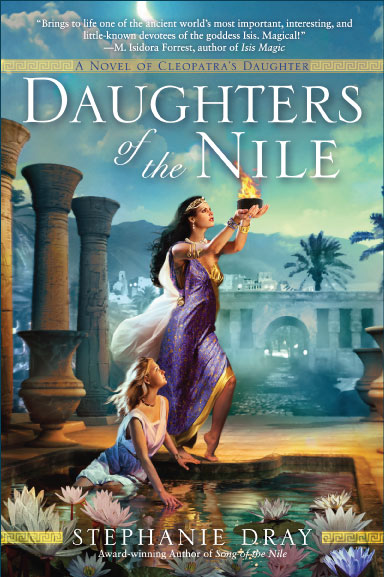
Daughters of the Nile cover

Available now in print and e-book!


Available now in print and e-book!


Stephanie Dray Headshot
STEPHANIE DRAY is a bestselling, multi-published, award-winning author of historical women’s fiction and fantasy set in the ancient world. Her critically acclaimed historical series about Cleopatra’s daughter has been translated into more than six different languages, was nominated for a RITA Award and won the Golden Leaf. Her focus on Ptolemaic Egypt and Augustan Age Rome has given her a unique perspective on the consequences of Egypt's ancient clash with Rome, both in terms of the still-extant tensions between East and West as well as the worldwide decline of female-oriented religion. Before she wrote novels, Stephanie was a lawyer, a game designer, and a teacher. Now she uses the transformative power of magic realism to illuminate the stories of women in history and inspire the young women of today. She remains fascinated by all things Roman or Egyptian and has-to the consternation of her devoted husband-collected a house full of cats and ancient artifacts.

Tuesday, November 8, 2011

Author Interview: Stephanie Dray + Giveaway (US)!

Please Welcome Stephanie Dray!

Stephanie Dray is the author of the Cleopatra's Daughter series, which currently includes Lily of the Nile and Song of the Nile. I LOVED both books for so many reasons, but I especially appreciated the historical approach Stephanie Dray has taken, which she explains in a little more detail below!


 There are NO spoilers here!


Why Do You Hate Ancient Romans So Much?
(And Other Frequently Asked Questions)

by
Stephanie Dray


A few years ago, I was enraptured by the life story of a nine year old Egyptian princess who was taken prisoner by the Romans, dragged through the streets in chains, and yet went on to be the most powerful queen in Augustus’ empire. I decided to write some books about her, the most recent of which is Song of the Nile: A Novel of Cleopatra’s Daughter.

Because I’ve spent so long studying Cleopatra Selene, I get asked a lot of strange questions ranging from whether or not the Egyptians really had turquoise (they did) to the true location of Cleopatra’s tomb (nobody knows). But one thing that keeps cropping up again and again: why do you hate the ancient Romans so much?

Now, the heroine of my novels doesn’t think much of the Romans. She wouldn’t. She was a Hellenized princess who--although half-Roman by blood--spent her young life in Egypt. An Egypt she was almost certainly raised to believe that she would rule as queen. In writing my novels, I assumed that even the most mature teenager, no matter how nuanced to the vagaries of power, would be resentful of having her kingdom taken away from her. Perhaps she would be even more resentful of having been dragged through the streets as a chained captive. Knowing that her life and her future was at the mercy of the very man who forced her parents to suicide can’t have endeared them to her. And she was bound to have had culture shock.

So, I made Cleopatra Selene hate the Romans. That doesn’t mean I do.

As I say in the beginning of Lily of the Nile in a note to my readers, the anti-Roman bias belongs to my heroine. I’m quite an admirer of ancient Romans, from whom we’ve inherited almost all our best and worst qualities. Sure, the Romans had gladiator games. They kept slaves. They were a colonial power who conquered the lands around them and stole their wealth. They practiced infanticide and had very creative ways of executing prisoners.

But the Romans also had a genius for organization and order; with the Romans came roads, water, concrete that hardened under water, magnificent architecture, and law. In fact, even though they are primarily known for the excesses of mad emperors--the Romans believed in, and often achieved, good governance. To someone like me, whose primary focus of study in school was Government, that’s reason enough to admire them.

They were not the ancient world equivalent of the Nazis. Many of the wars they fought, they were drawn into by virtue of being a super power, in an effort to restore peace. (Not that they didn’t take advantage of such situations, but then again, when has any super power not taken advantage of it?) And even though they went around conquering people, they really wanted to bring new cultures into the fold. Slaves could achieve their freedom and their children could be citizens with full rights. There was, in fact, an astonishing amount of social mobility.

In short, I love the Romans and I love writing about them. While some of the Roman characters in my novels seem irredeemable (like the emperor’s wife, Livia), I lavished a lot of loving attention on Octavia, Agrippa, Marcella, and the Antonias...people who Selene initially loathed, but came to love. I treat Virgil with affectionate kid gloves, and Julia--the emperor’s daughter--may have been my favorite character in the book next to Selene!

So, in short, I don’t hate the Romans. I just love looking at them through Selene’s eyes and I hope my readers will too!


Stephanie Dray's bio:

Stephanie graduated from Smith, a small women’s college in Massachusetts where–to the consternation of her devoted professors–she was unable to master Latin. However, her focus on Middle Eastern Studies gave her a deeper understanding of the consequences of Egypt’s ancient clash with Rome, both in terms of the still-extant tensions between East and West as well as the worldwide decline of female-oriented religion.

Before she wrote novels, Stephanie was a lawyer, a game designer, and a teacher. Now she uses the transformative power of magic realism to illuminate the stories of women in history and inspire the young women of today. She remains fascinated by all things Roman or Egyptian and has–to the consternation of her devoted husband–collected a house full of cats and ancient artifacts.


Thank you so much for stopping by, Stephanie!

What do you think about Stephanie Dray's approach? Do you prefer to read historical fantasy where the author embraces the emotional perspective of the main character, or do you want pure objectivity?


Personally, while I appreciate objectivity, I really like it when the author gets inside the head of the main character. If you read my reviews, you know Stephanie Dray was very effective in making me join Selene in cursing the Romans!


Stephanie Dray is generously providing a copy of Song of the Nile for giveaway!


Sorceress. Seductress. Schemer. Cleopatra’s daughter has become the emperor’s most unlikely apprentice and the one woman who can destroy his empire…Having survived her perilous childhood as a royal captive of Rome, Selene pledged her loyalty to Augustus and swore she would become his very own Cleopatra. Now the young queen faces an uncertain destiny in a foreign land.

Forced to marry a man of the emperor’s choosing, Selene will not allow her new husband to rule in her name. She quickly establishes herself as a capable leader in her own right and as a religious icon. Beginning the hard work of building a new nation, she wins the love of her new subjects and makes herself vital to Rome by bringing forth bountiful harvests.

But it’s the magic of Isis flowing through her veins that makes her indispensable to the emperor. Against a backdrop of imperial politics and religious persecution, Cleopatra’s daughter beguiles her way to the very precipice of power. She has never forgotten her birthright, but will the price of her mother’s throne be more than she’s willing to pay?

Info for the giveaway:
  • As always, you do NOT have to be a follower
  • You must have a US mailing address
  • You must be 13 years of age or older
  • One entry per person
  • Your address is not required, but including it will help with sending the book out to you sooner
  • I will contact the winner through email and the winner will have 24 hours to reply before a new winner is chosen 
  • This giveaway will close December 7th


Visit Ruby today for a guest post by one of her favorite authors and an international giveaway! Check out our Historical Fantasy Jubilee full schedule of events and giveaways!

Have you entered to win our prize pack giveaways?

Monday, November 7, 2011

Book Review: Song of the Nile by Stephanie Dray

Song of the Nile by Stephanie Dray
Release Date: October 4, 2011
Publisher: Berkley Trade/Penguin
Pages: 416
Series: Cleopatra's Daughter #2
Received: ARC from author
Rating: 5 out of 5 stars, Special Shelf
Goodreads Page


There are NO major spoilers in this review, but if I mention a character, then you can kind of figure out that they didn't die in the first book.

Really worried? Click here to read my review of the first book, Lily of the Nile instead!


Summary

From Goodreads:

Sorceress. Seductress. Schemer. Cleopatra's daughter is the one woman with the power to destroy an empire...

Having survived her perilous childhood as a royal captive of Rome, Selene pledged her loyalty to Augustus and swore she would become his very own Cleopatra. Now the young queen faces an uncertain destiny in a foreign land.

The magic of Isis flowing through her veins is what makes her indispensable to the emperor. Against a backdrop of imperial politics and religious persecution, Cleopatra's daughter beguiles her way to the very precipice of power. She has never forgotten her birthright, but will the price of her mother's throne be more than she's willing to pay?

Review

Fire up the Delorean

Song of the Nile picks up right where Lily of the Nile left off and I was immediately sucked back into Selene's world. I don't know whether it is Selene's captivating first person narrative or if it is Stephanie Dray's meticulous attention to detail, but rarely have I been so thoroughly absorbed in a book as I was with this series.

I could clearly picture everything Selene saw, taste what she ate, and feel what she felt. I felt like I was growing and changing along with Selene as she developed as a mother and a ruler.

At one point, I was so into what I was reading that I actually angrily cursed a character who was INFURIATING me for the way they were treating Selene. It was totally an involuntary reaction, and I cursed them vehemently...and, erm, out loud (that was an interesting reaction to explain because I was NOT alone when that happened. But luckily I was not at work, either).

I am so proud of you!

Selene's growth was tremendous, and while she matured a lot in Lily of the Nile, she still had a long way to go. Song of the Nile sees her finally breaking the shackles of her past and becoming the mighty woman I knew she could be. I am so proud of her.

But Selene's triumph comes late in the book and the time leading up to that is filled with delicious tension (oh my gosh--white knuckled, PLEASE THAT CAN'T HAPPEN! kind of tension!). The game of political chess Selene engaged in with Octavian in Lily of the Nile continues in Song of the Nile, but the stakes are higher. Selene's position is significantly more powerful than it was, but instead of adding security that only elevated the danger.

Like her mother before her, Selene uses her sexuality as a weapon and a snare. However, Selene is not simply another version of Cleopatra. She is both like and unlike her mother, and this internal struggle over following in her mother's footsteps or finding her own path takes a more prominent role in Song of the Nile. Selene's struggle to find herself and the right path for her--despite the expectations of others, resonated strongly with me.

A note on the historical accuracy

This is historical fiction, but it is not a straight restatement of events. Many of the events did happen, however, after looking into Selene's history a little (and reading the author's note), it seems like documentation of Selene's life is pretty sparse.

The more specific things Selene does in Song of the Nile are not backed up by history (as far as my very limited research shows), but they are not contradicted either. We just don't know. So could Selene have engaged in intense political and personal sparring with Octavian? Possibly.

Even more important (to me) is that Stephanie Dray wove in her fiction with reality in such a way that her fiction enhances and explains the gaps in what we know of the historical facts while staying true to the spirit and personalities of the historical players. Her characterizations of the Roman characters, especially through what would have likely been Selene's perspective, seems spot on to me.

Romance?

Whoa baby! Everything I was hoping would happen did happen. Remember, this is an upper YA/Adult book.

And I'll just leave it at that.

Bottom line

There is another book planned, but Song of the Nile ends perfectly and more isn't necessary to make the story feel complete (but more is totally welcome!)

I really hope Stephanie Dray continues to write historical fiction because she is now solidly on my (very short) list of favorite historical fiction writers. I am left breathless by her powerhouse combination of tangible world building, historical reverence, fluid writing, and incredible character depth. More, please?


Explanation of rating system: Star Rating Key 


Do you have any questions about Song of the Nile that I haven't addressed? 
Feel free to ask in the comments!

Stay tuned tomorrow for a guest post by Stephanie Dray and a chance to win your own copy of Song of the Nile!


Looking for another book like this? 
You might like: 


Click on the covers to go to my reviews.


Ruby has a list for you today about one of her favorite historical fantasy authors, check it out! Check out our Historical Fantasy Jubilee full schedule of events and giveaways!

Have you entered to win our prize pack giveaways?

Sunday, November 6, 2011

Book Review: Lily of the Nile by Stephanie Dray

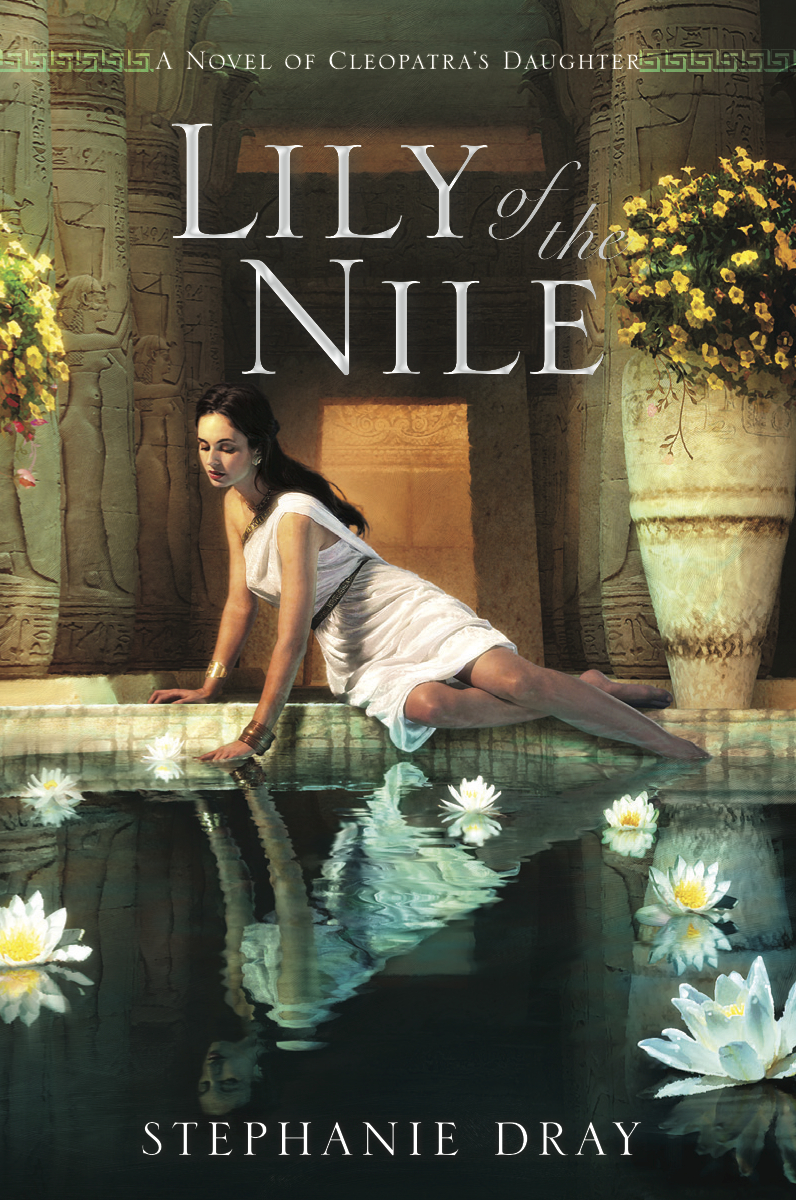
Lily of the Nile by Stephanie Dray
Release Date: January 4, 2011
Publisher: Berkley Trade/Penguin
Pages: 351
Series: Cleopatra's Daughter #1
Received: Library
Rating: 5 out of 5 stars


Summary

From Goodreads:

Heiress of one empire and prisoner of another, it is up to the daughter of Cleopatra to save her brothers and reclaim what is rightfully hers...

To Isis worshippers, Princess Selene and her twin brother Helios embody the divine celestial pair who will bring about a Golden Age. But when Selene's parents are vanquished by Rome, her auspicious birth becomes a curse. Trapped in an empire that reviles her heritage and suspects her faith, the young messianic princess struggles for survival in a Roman court of intrigue. She can't hide the hieroglyphics that carve themselves into her hands, nor can she stop the emperor from using her powers for his own ends.

But faced with a new and ruthless Caesar who is obsessed with having a Cleopatra of his very own, Selene is determined to resurrect her mother's dreams. Can she succeed where her mother failed? And what will it cost her in a political game where the only rule is win-or die?


Review

Historical fiction with a capital H

Usually I make a distinction between historical fiction lite and Historical fiction (these are my own made up terms). The former uses an historical backdrop, but it isn't the focal point of the story and oftentimes features and character perceptions are modernized.

The latter is for historical fiction buffs--readers who want to be absorbed into the past and live and breathe the historical setting. Lily of the Nile is firmly in the latter category. It is clear that Stephanie Dray spent countless hours immersing herself in the world of Cleopatra Selene (Cleopatra's daughter) and the people who populated her life.

Minute details--from the clothing worn to the food eaten to the architecture and decor--are included in such a way that I felt like I was living in Selene's world. Never did Lily of the Nile feel like a textbook, dryly relating historical details. Instead, Stephanie Dray has invented a time machine, fully transporting me into Selene's turbulent world.

That said, there are magical elements that are, obviously, fictional, though they are woven in so seamlessly that they feel entirely natural.

But, erm, sometimes historical fiction can be boring...

As much as I love historical fiction, even with a capital H, I'm still an impatient reader. I like action and characters I can love and I don't like long periods of filler. So while I love the genre, I readily admit that a whole lotta Historical fiction books are BOR-ING!

So when I I looked at that large page count (hey, I'm impatient, 351 pages is a lot for me!), I cringed a little. But I started reading and before I knew it I was halfway through and my family was giving me puppy dog eyes because I had forgotten to make dinner (yes, this book made me forget about food. That's saying something).

After finishing dinner I dove back in and when I turned that final page I thought my heart would break because the book was over and I didn't have the sequel on hand. So basically what I'm saying here is: Lily of the Nile = So NOT boring!

A treasure trove of characters

One thing that can make Historical fiction boring is an over-focus on the setting and major events and not enough focus on developing the characters. Sure, they're historical figures and I know them in a textbook approach, but when I read historical fiction I want to know them. I want them to come alive off the page and be more than just the events they are known for.

On this, Stephanie Dray delivered. Even characters like Cleopatra and Mark Antony (who are dead from the outset) felt fully alive. I've read a decent bit about Cleopatra, and Stephanie Dray's version--a woman seen only through the memory of the characters--is just as vibrant and developed as she is in the books that focus on her story.

Octavian, Livia, Octavia, Julia, Helios, and all of the other major players in Selene's life are as nuanced and developed as if they were the main character. They may not have been the main character, but they each still score highly on the WWMCD Test.

But this is Selene's story

I'm totally swapping BFF charms with Selene. She grows tremendously throughout the course of the book, evoking and grappling with the legacies of both her famous mother and father, but ultimately becoming a strong woman in her own right.

Usually when I think of fierce fighters, I think of characters who are physically fierce. Selene isn't a physical fighter. She is a shrewd strategist, fighting her battles through politics, leadership, and manipulation.

She is pitted against the emperor Octavian, presented here through Selene's perspective as a vile man prone to insecurities but brilliant at maneuvering those around him. Watching these two go head to head in a battle of wits was as tense and captivating as the most action-packed battle scenes.

The pacing isn't fast, but it is steady and deliberate. This isn't a fight to be won quickly. This is the kind of fight where both parties plan elaborate schemes that will unfold across decades.

But I'm not just swapping BFF charms because I admire Selene. Lily of the Nile is told through Selene's first person narration, and as such not only was I able to observe her prowess, but I was also privy to her insecurities, hopes, and fears. I really felt like we were best friends.

"Insecurities" is more often than not a DO NOT WANT word for me because there are few things that annoy me more than a wishy washy character who is all woe is me blah blah blah, but Selene's insecurities were not annoying. Her situation is serious--that she reflected on the consequences of her actions and the way her life and upbringing shaped her personality just made her that much more real and relatable to me.

Is there romance?

Lily of the Nile follows Selene's life from when she's 10 to 14 years old, which is young, but they also did things differently back then (and don't let her age give off the wrong idea--this is a YA/adult crossover book, NOT a MG book).

Selene explores her feelings for a man (and if you know your history, then you'll know what happens with him). My feelings for him progressed exactly the way Selene's feelings developed and changed. But I won't tell you any more about that because watching it all unfold and wondering how it will work out is half the fun.

But, as a twin from Egypt raised in the Egyptian culture, she also has a...more than sisterly bond with her twin brother. Yeah, it can be a little uncomfortable coming from a modern perspective (especially considering how freaking hot her brother is--hey, *I* can admire him all I want...except, he's, uh, young. See the mental knots this has me tied up in?!) but I kept having to remind myself that I can't judge them based on my social norms.

Still, the romantic action Selene sees is totally PG--with the exception of one horrible scene where she is raped. The sequel will probably step this up and then I can really get twisted up in my head while I root for her brother to erm, nevermind.

Bottom line

As long as Stephanie Dray writes historical fiction, I will read it. Heck, I will auto-buy it, and I almost never do that!

There is a sequel and while Lily of the Nile doesn't end on a cliffhanger, per se, it does end right in the middle of her life and at a crucial turning point.

I have read a lot about Cleopatra and my Roman history of this time is pretty decent on the broad strokes, but fuzzier on the details. This is the first book I've read that focuses on Selene. I don't think being a history buff on the time period is necessary to enjoy it, but a basic familiarity with Cleopatra's reign and Roman history at this time would probably be helpful. There is a handy character list at the front of the book and I recommend reading the author's intro and afterward.


Explanation of rating system: Star Rating Key 


Do you have any questions about Lily of the Nile that I haven't addressed? 
Feel free to ask in the comments!


Looking for another book like this? 
You might like: 

Click on the covers to go to my reviews.


Are you a lover of pretty things? If so, you're going to want to check out Ruby's cover post today! Check out our Historical Fantasy Jubilee full schedule of events and giveaways!

Have you entered to win our prize pack giveaways?

Saturday, November 5, 2011

Spotlight List: 5 Reasons I Love Historical Fantasy


1. Opportunities for humor

I like to laugh, and historical fantasy is a genre ripe for humor. Just take the fantasy element of time travel, for example. The "fish out of water" possibilities are endless!

One of my all time favorite humorous scenes was in Emily Whitman's Wildwing where the main character totally flubs the dining conventions of the time.

Then, to make things even funnier, Emily Whitman gives us a peek into one of the local's impressions of the time traveler--showing that she didn't pull things off anywhere near as well as she thought!


2. Makes it feel like magic could be real

Perhaps it's because, deep down (or, not so deep), I want to be a fairy tale princess (minus the evil stepmother or curses, plus the handsome prince), but a part of me is still holding out hope that I can live in a world where magic actually exists.

Of course that's unlikely to happen, so immersing myself in historical fantasy worlds is the next best thing! The historical part grounds me in the real world so the story feels like it could actually happen, and then the fantasy part makes my dreams come true.

Check out Stephanie Dray's books about Cleopatra's daughter Selene for an example of magic and history coming together seamlessly.


3. Hot guys

I am a firm believer that a hot man will become ten times hotter if he wields a sword. And do you know how common a sword-wielding hero is in historical fantasy??

VERY common.

Plus, historical men oozed with chivalry goodness. Just look at Lisa T. Bergren's River of Time series for an example of how unbelievably hot historical fantasy men can be.


4. Women's roles are more interesting

Let's face it, the life of most women in history was booor-rriiinng! Sure authors can make a totally spunky female lead who doesn't follow any of the conventions of her time, but that's a very tricky thing to do and still make the book feel historical and be true to the historical setting.

So enter historical fantasy. Suddenly that boring life is made interesting because maybe she can do magic spells, or see the future, or time travel, or do any number of fantastical things. Instantly better (without being anachronistic!).

The fantasy aspects also let me stretch my rigid historical standards a little. I can more easily buy that a woman would be a master assassin in a world where magic also exists.


5. History + Fantasy = 
The perfect combo

Historical fiction and fantasy are two of my favorite genres ever. Combining the two is simply perfection!


What are some of the reasons you love the genre? Which books are some of your favorite examples?

Dislike any of these features? Feel free to share why!


What about on the author's end of things? Why do authors like writing historical fantasy? Ruby has the answer (and a giveaway) today!

Check out our Historical Fantasy Jubilee full schedule of events and giveaways!

Have you entered to win our prize pack giveaways?

Related Posts Plugin for WordPress, Blogger...